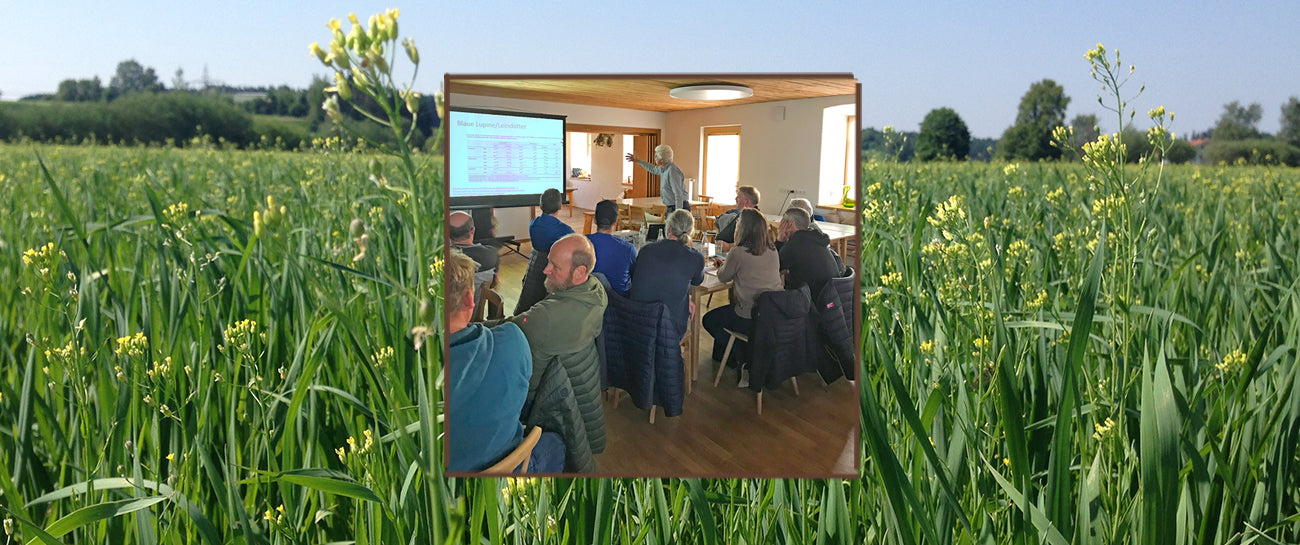
We want to use mixed cropping to contribute to biodiversity and soil health. And that is precisely why only oat and spelt flakes that are grown in mixed culture go into your Krunchy. Mixed culture means: Our cereals grow together with another crop on the field. Together with the Barnhouse farmers, this topic is very important to us. That is why we support their cultivation trials with mixed crops both conceptually and financially.
To further intensify this cultivation option, we invited Max Kainz, organic farmer and employee of the Chair of Organic Farming at the Technical University of Munich, at the end of January. In an exciting workshop, our farmers not only learned a lot about growing cereals in mixed culture, but also developed suitable crop combinations for organic intercropping themselves.
The first priority for our farmers here is gold-of-pleasure, which is already predominantly used. This is because it is cost-effective, uncomplicated to grow - and blossoms for wild bees during a rather flower-scarce period. In addition, it subordinates itself to the main crop (companion plant), but at the same time fills possible gaps (risk compensation) and can be easily cleaned out.
Another idea was mustard due to its long and good flowering effect. However, since mustard and oats have very similar site requirements, the compensatory effect and therefore the risk compensation - unlike with gold-of-pleasure - is low.
But various legumes were also discussed as potential mixed partners. They have the advantage of supplying the main crop with nitrogen and having a good flowering effect.
And clover grass was also mentioned, which ensures good ground cover and a longer-lasting flowering effect.
Another suggestion was winter field beans. They are particularly interesting in crop rotations with a high proportion of summer crops (potatoes, soy). Even if the requirements of oats and field beans do not quite match (field beans, for example, need a significantly deeper sowing), they also bring advantages to oats: They offer risk compensation and bring a nitrogen transfer of up to 40 kg. And the bees are happy too, because the field beans bloom for a long time.
Oat-lentil cultivation met with great interest among the participants - mainly because lentils are of interest to us at Barnhouse as a raw material. We currently use red lentils in our Krunchy Linse, but we currently need them in a pre-processed state. We will examine to what extent other types of lentils - such as green lentils - are also suitable as a base for Krunchy.
Which mixed crop our farmers choose naturally depends on many factors such as local conditions, farm structure and the preferences of the farmers. With a test cultivation, which we support conceptually and financially with Barnhouse, they can certainly approach the critical questions and gradually work their way towards successful intercropping. Let's see what initiative for intercropping develops from the community of Barnhouse farmers. After the upcoming harvest at the latest, we will all meet again to exchange the various experiences. We are excited.

shares:
Form an opinion on New Genetic Engineering!
Biofach 2024!