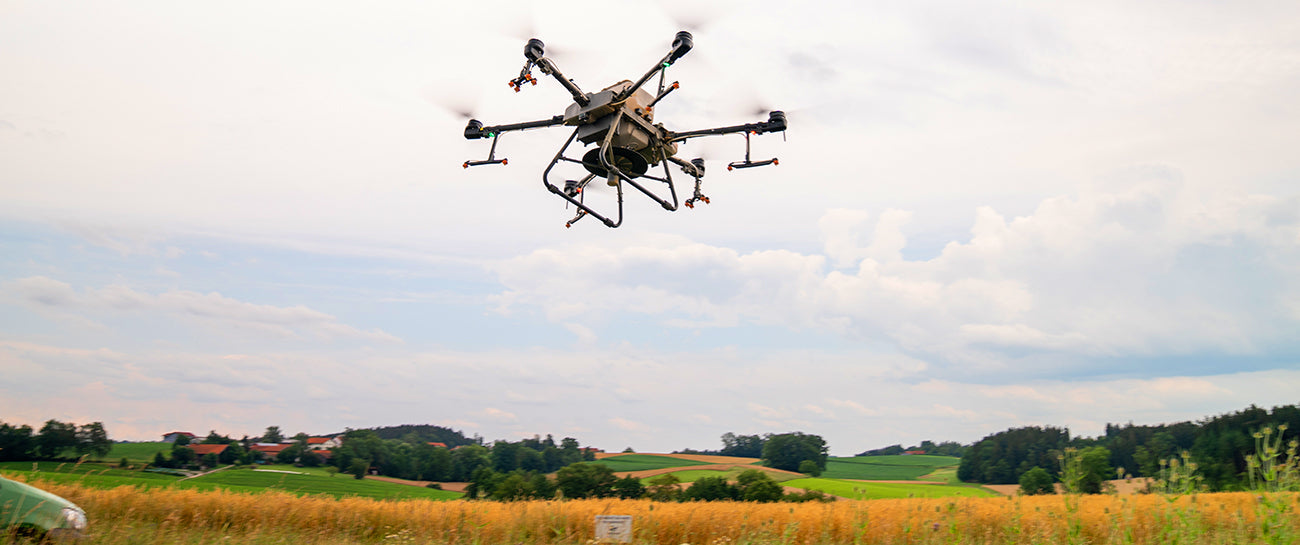
Together with our regional Barnhouse farmers, we have launched a new and innovative project. As part of a trial, we provided a modern agricultural drone, including pilot and seeds, free of charge in July. On test plots where the Barnhouse oats for your Krunchy are still growing, the cover crop has already been sown. This forward-looking technology offers various benefits for the environment and farmers, such as soil-conserving and weather-independent sowing of cover crops, even while the main crop is still in the field. This represents a significant advance in agricultural practice. The project aims to evaluate the efficiency and practical benefits of this method and to analyze the results of drone seeding in cover crop cultivation.
Watch our video with exciting impressions from the test on YouTube.
Catch crops are grown after or before other main crops as green manure or for use as animal feed and serve to improve crop rotation in terms of diversity. They are particularly important in organic farming: catch crops maintain and improve soil fertility, promote the yield and health of the subsequent crop, and protect the soil through vegetation.

The advantages of drone sowing
“Seeding with drones offers compelling advantages. The heavy weight of traditional farm machinery often compacts the soil during seeding and damages its structure. The specialized drone, on the other hand, hovers above the ground and distributes the seed evenly and precisely without putting pressure on the soil. In the long term, this is expected to improve soil quality and health,” explains our CEO, Martin Eras. “Another significant advantage is the ability to sow cover crops while the main crop is still in the field. This shortens the interval between crops and ensures that the field remains continuously covered, which prevents erosion and nutrient loss.” Thanks to drone technology, sowing is no longer dependent on the weather and the resulting soil conditions. This is because, during periods of drought or heavy rain, sowing with a conventional tractor can cause damage or may even be temporarily impossible.

Barnhouse farmer Gerhard Schweiger fills the drone with seeds.
Many thanks to Fabian Rupprecht from Drohnenservice Rupprecht!

shares:
Hilarius is Barnhouse's very first farmer
TV chef and Michelin-starred chef Alexander Herrmann visits Barnhouse